Why doesn’t Tiwal offer a Hypalon hull?
While Hypalon is the undisputed gold standard for durability in the inflatable boating world, PVC remains the superior choice for high-pressure dropstitch hulls, like Tiwal sailboats and SUPs, for several technical and economic reasons. The breakdown.
1. Assembly: Welding vs. Gluing
PVC is compatible with thermal or High-Frequency (HF) welding. This process fuses the material layers into a single, homogenous mechanical bond that is incredibly strong. Since 2021, all Tiwal hulls have been fully assembled using this method, ensuring a long-lasting, airtight seal that stands up to the stress of repeated high-pressure inflation.
Hypalon, on the other hand, cannot be welded. It must be cold-glued by hand using overlapping strips. This requires labor-intensive surface sanding followed by multiple layers of adhesive. This is a proven technique for low-pressure inflatables (like RIB tenders).
2. Weight
At an equivalent mechanical strength, Hypalon is significantly heavier than PVC. For products designed with portability and ease of transport in mind, this extra weight is a major disadvantage for the everyday user.
3. Cost
Hypalon carries a compounded cost disadvantage: the raw material is significantly more expensive than high-grade PVC, and the manual gluing process is far more time-consuming than industrial welding. Together, these factors result in a retail price that simply doesn’t align with the consumer market’s expectations.
The best of both worlds: double layer fusion PVC
To address PVC’s primary weakness compared to Hypalon, UV sensitivity, high-end dropstitch manufacturers have moved toward premium PVC with reinforced anti-UV treatments. Today, this “Fusion” approach offers the ultimate balance of lightweight portability, structural rigidity, and longevity, without the assembly constraints or prohibitive costs of Hypalon.
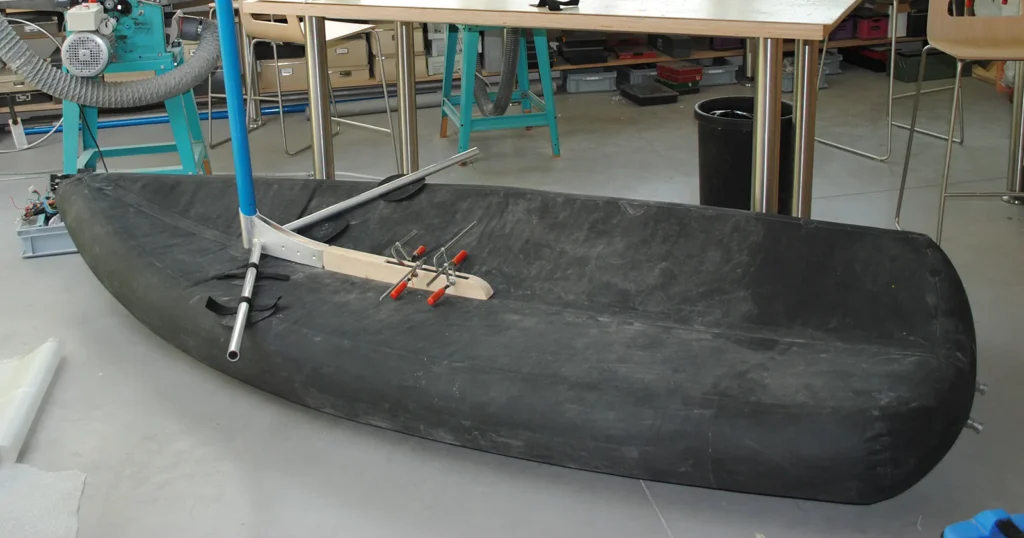
One last thing: despite what you might read online, dropstitch Hypalon does exist. It is primarily used for specialized industrial and military applications. In fact, Tiwal’s very first prototype was built using Hypalon. You can see a photo of that original hull here: